Eighteen flights in seven days: the air bridge from the UAE into Ethiopia kept flying
Six Il-76 freighters on the registers of Malawi, Burkina Faso and the Central African Republic made 18 flights on one route out of UAE airfields in a week, one into a UAE Air Force base. Four are recorded inside Ethiopia. Over the sea, their tracks go blank for about an hour.
By Adulis News · · 7 min read
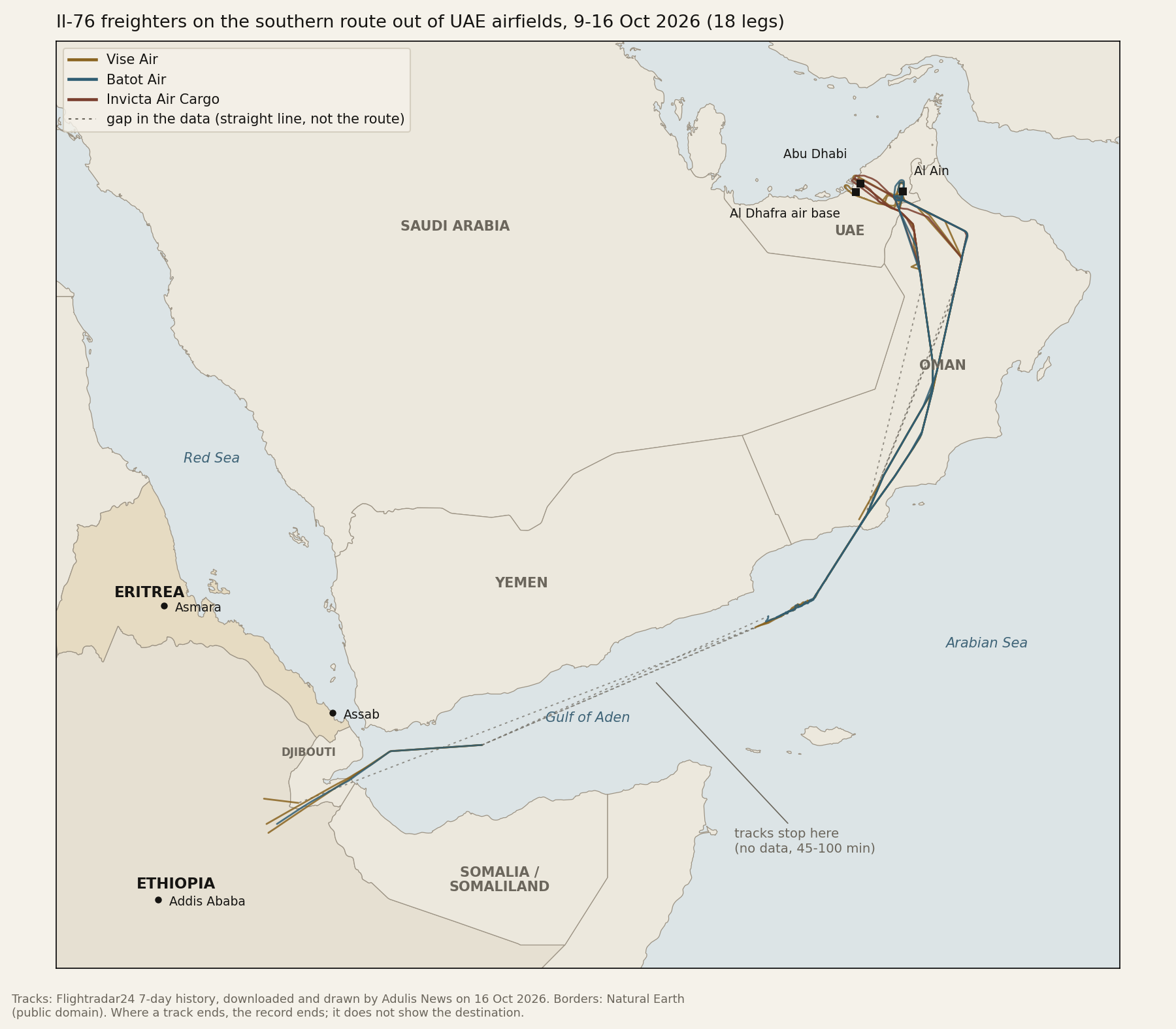
Between 9 and 16 October 2026, in the week after Ethiopia’s foreign minister accused Eritrea of an “all-out invasion”, six Soviet-built Ilyushin Il-76 cargo jets made 18 flights on one southern route out of airfields in the United Arab Emirates, according to the seven-day history of the public tracking site Flightradar24, which Adulis News downloaded and read point by point. Four of those flights are recorded inside Ethiopia’s airspace. One plane landed at Al Dhafra, a base of the UAE Air Force. None of the six is on the UAE’s register or Ethiopia’s: they carry the registration marks of Malawi, Burkina Faso and the Central African Republic.
Why we looked
On 30 September, Defense News reported that Aviacon Zitotrans, a Russian cargo airline under US sanctions, had flown “more than 100 missions” on behalf of the UAE government and its royal family since mid-2025 (Defense News). “A recurring destination was Ethiopia, particularly the Harar Meda Air Base,” the paper wrote, along with Addis Ababa’s international airport. The UAE government, the airline and Ethiopia’s embassies did not respond to it.
The US Treasury’s sanctions list confirms the airline’s planes. Entry 40184 is an IL-76TD, tail number RA-76846, under the Russia sanctions programme, “Linked To: JSC AVIACON ZITOTRANS” (OFAC). It was one of four Aviacon Il-76s that OFAC named in January 2023 (ch-aviation).
So we asked a question a public record can answer: two weeks later, is the air bridge from the UAE into Ethiopia still flying, and who flies it?
The sanctioned planes went elsewhere
In the seven days from 9 to 16 October, none of the four Aviacon Il-76s flew a recorded leg to Ethiopia. RA-76842 and RA-76846 recorded no flights at all. RA-76502 flew from Dubai to Russia, then on to Laos and India; RA-76834 flew from Vietnam to India. A flight that Flightradar24 did not record is not proof that no flight took place.
Six other planes did
In the same week, the record holds 18 flights by six Il-76s of three companies, as Flightradar24 lists them: Vise Air (7Q-VZZ, 7Q-VAA and 7Q-VAF, registered in Malawi), Batot Air (XT-ABL and XT-ABG, Burkina Faso) and Invicta Air Cargo (TL-ATB, Central African Republic). Nine flights left the UAE heading south: six from Al Ain and three from Abu Dhabi. Nine came back north: four to Al Ain, four to Abu Dhabi (one of them counted from its track, which Flightradar24 gives no destination) and one to Al Dhafra Air Base. Defense News described the same airfields for Aviacon’s flights: “usually” Al Ain, Abu Dhabi, “or, more rarely, a military base in the UAE”.
On the night of 10 October, Vise Air’s 7Q-VZZ flew up from the south, and its track ends at 22:11 UTC 1.9 kilometres from Al Dhafra Air Base, at 200 feet. Less than two hours later it is recorded on the ground at Al Dhafra, before it flew on to Al Ain. Al Dhafra is a UAE Air Force base that also hosts US forces (Wikipedia; US Air Forces Central).
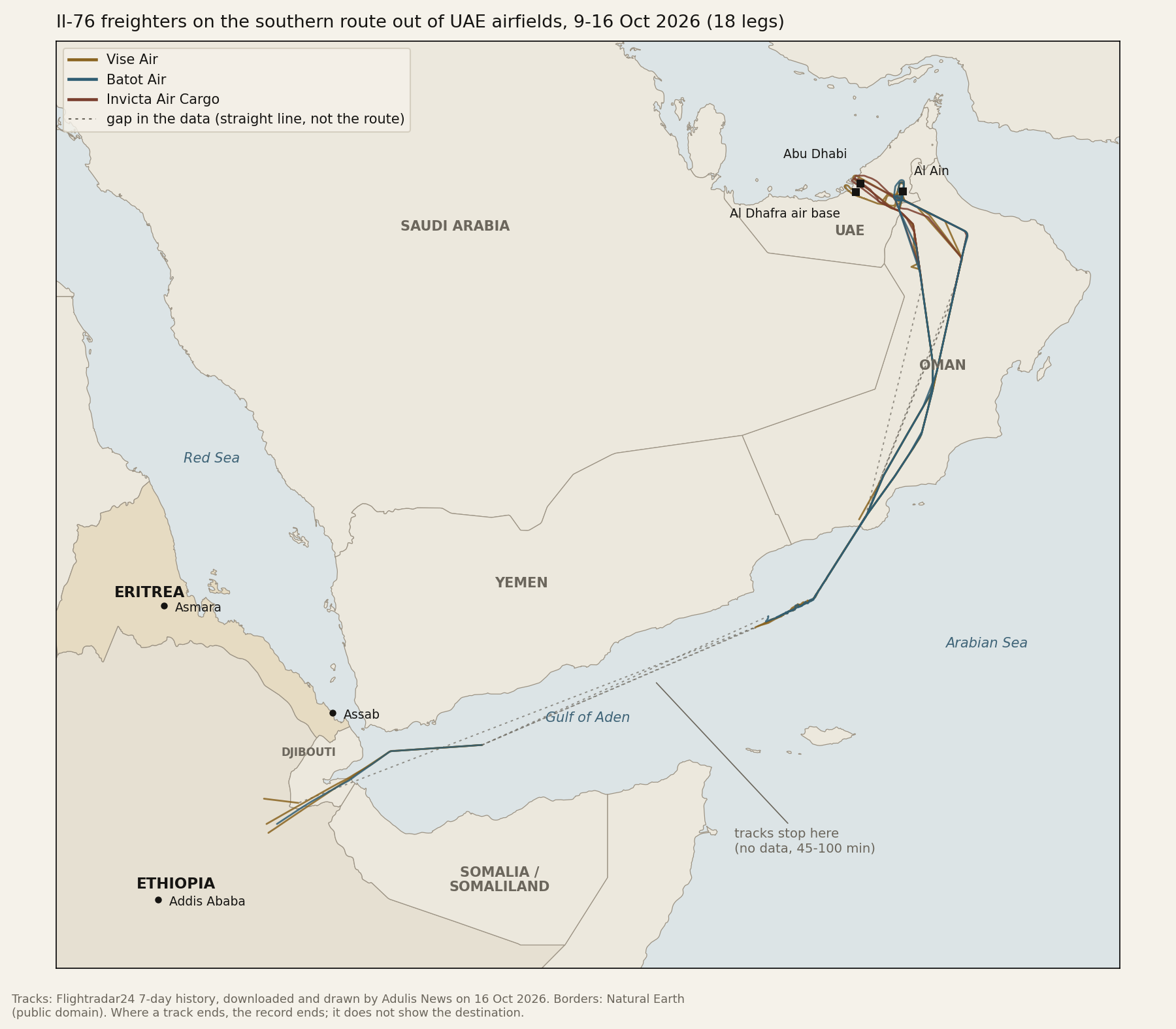 All 18 recorded flights, 9-16 October 2026. Dotted lines join the last position before a gap to the first after it; they are not the route flown. Adulis News, from Flightradar24 data; borders: Natural Earth.
Into Ethiopia
Four flights are recorded inside Ethiopia: Batot Air’s XT-ABL on 9 October and Vise Air’s 7Q-VAF on 15-16 October, both flying back to the UAE, and Vise Air’s 7Q-VAA on 15 October and 7Q-VAF on 16 October, flying in. On these legs the planes cross Djibouti at about 32,000 to 35,000 feet. 7Q-VAF was first recorded over Al Ain at 04:18 UTC on 16 October and last recorded over Ethiopia at 08:01 UTC, still at 34,025 feet. The last recorded positions of the two inbound flights are about 320 to 360 kilometres from Addis Ababa and from Bishoftu, home of the Harar Meda air base.
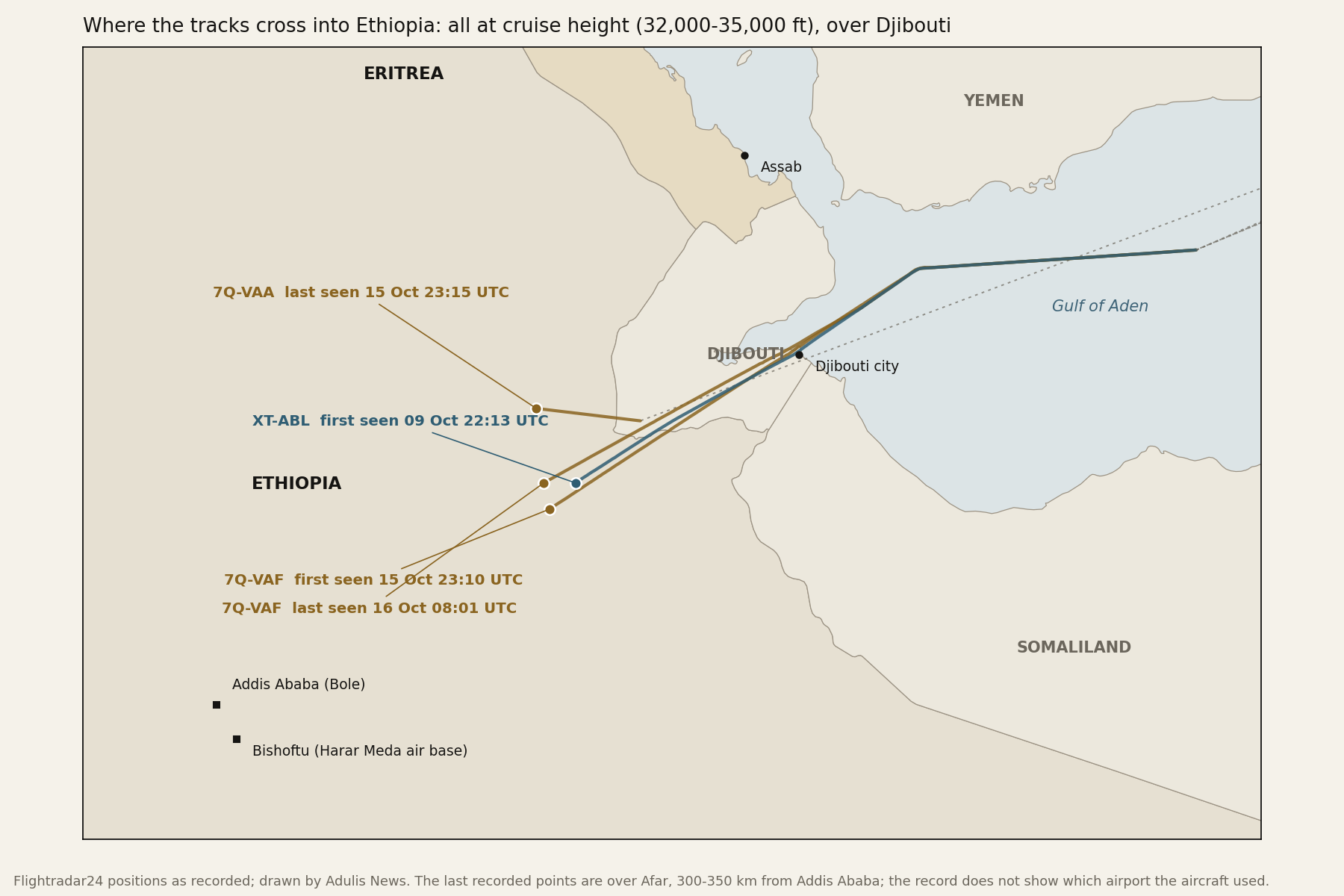 The four flights recorded inside Ethiopia, with the first or last recorded position of each. Adulis News, from Flightradar24 data; borders: Natural Earth.
An hour with no record
Ethiopian Airlines flies the same corridor, from Dubai to Addis Ababa. On the five flights ET601 and ET603 with recorded arrivals between 10 and 14 October, the longest stretch with no recorded position, between the Arabian Sea and the Gulf of Aden, was 7 to 15 minutes. On the four Il-76 flights we could follow across the Gulf of Aden, it was 56, 58, 60 and 101 minutes.
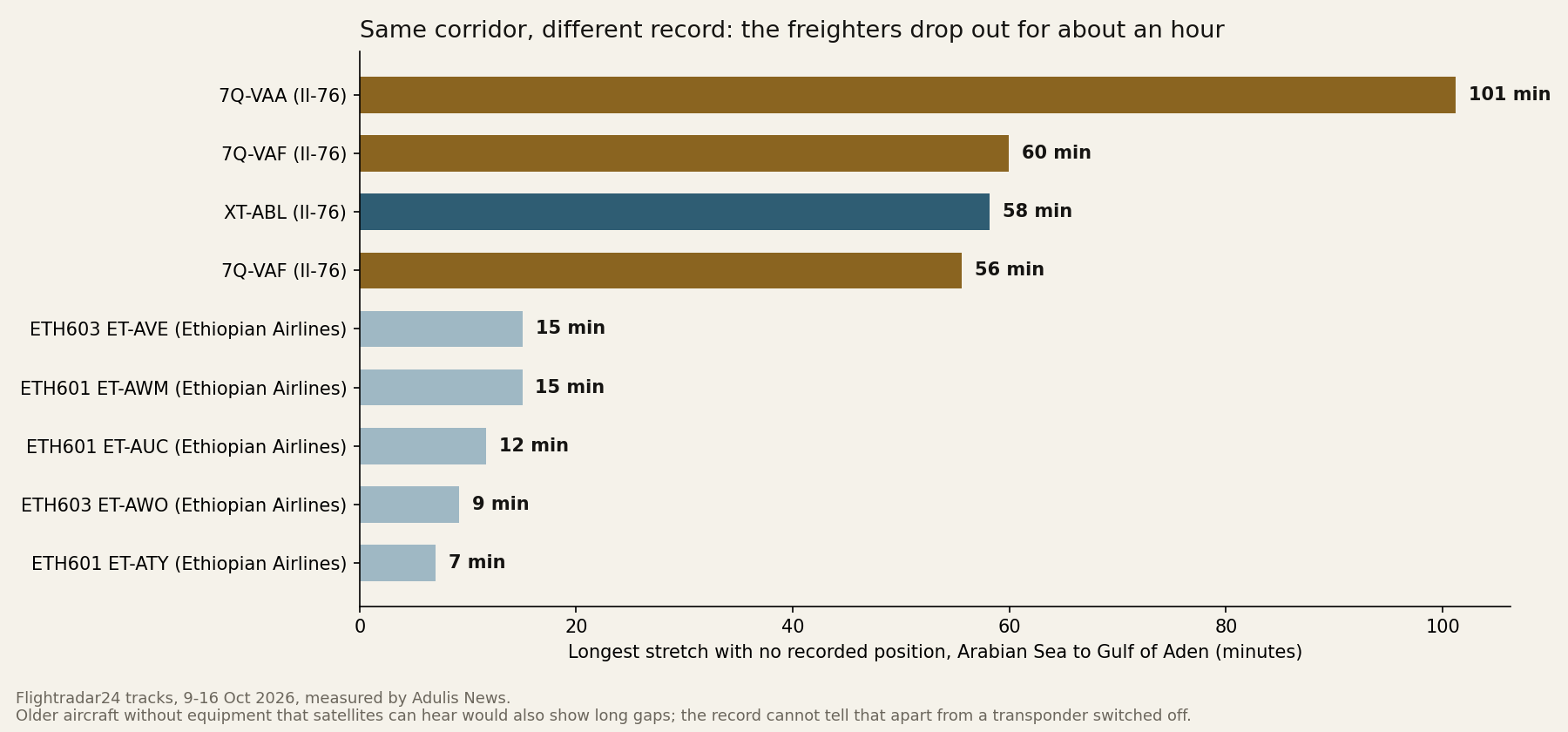 The longest stretch with no recorded position on the same corridor, 9-16 October 2026: Il-76 flights against Ethiopian Airlines flights. Measured by Adulis News from Flightradar24 data.
Defense News found the same with Aviacon’s planes: the aircraft “would then fly south and west to the Gulf of Aden, where its transponder track would disappear”. The record has a plainer explanation too. Flightradar24 says that over the ocean “only aircraft equipped with an ADS-B transponder may be tracked via satellite”, and that its method for older transponders needs four or more ground receivers (Flightradar24). The gaps on the Il-76 flights begin and end at almost the same points on different days and different aircraft, which fits the edge of ground coverage.
The companies
According to Le Monde, as reported by the Africa Defense Forum, Batot Air was set up in Burkina Faso with “just over $17,000 in the bank”, and its listed owner is a Sudanese businessman, Mohamed Omer Suleiman Idriss (ADF). We found no company record for Vise Air or Invicta Air Cargo; Flightradar24 lists them as the operators. An independent flight tracker, Rich Tedd (AfriMEOSINT), counted 46 flights from the UAE to Ethiopia in August, and wrote that he had logged 356 “suspicious UAE cargo/military flights” to Ethiopia since January. Those are his counts, not ours.
What is not known
Nothing in a flight track shows what a plane carries, and we have no evidence that these flights carried weapons. The record does not show where the inbound flights landed, or who chartered them. The UAE did not answer Defense News; a UAE official told AFP in May that accusations over Sudan’s war were “fabrications” and “part of a calculated pattern of deflection” (Al Jazeera). Flightradar24’s free history covers only one week, so we cannot say from our own data whether this week was busier or quieter than August or September.
Analysis: the other half of the public record
Ethiopia’s foreign minister, Gedion Timothewos, wrote to members of the UN Security Council on 8 October that “the all-out invasion of parts of northern Ethiopia by Eritrea is a matter of public record” (Al Jazeera). Eritrea denies it, and in a note circulated to the Council on 13 October said Ethiopia “has been involved in a massive shopping spree of weapons sponsored by destabilizing external actors” (Shabait). On 8 October, Reuters reported drone strikes on Eritrean military vehicles near Adigrat, believed to have been carried out by Ethiopia’s military, citing the conflict monitor ACLED (Reuters); a day earlier Eritrea’s information minister, Yemane Gebremeskel, had denied that Eritrean forces were in the town (Reuters).
A flight track cannot settle what these planes carried. But it is a public record too, and it shows something Ethiopia’s letter leaves out: in the week after that letter, a steady air bridge ran from UAE airfields into Ethiopia’s airspace, flown by planes registered far from both countries, whose tracks went blank over the sea; one of those planes came back to a UAE Air Force base.
The UAE has been on this coast before. AP reported that it built a port and expanded an airstrip at Assab, on Eritrea’s coast, “beginning in September 2015”, and satellite images analysed by AP showed it dismantling the base in early 2021 (AP via VOA). Eritrea’s border was settled by the Eritrea-Ethiopia Boundary Commission in 2002, and Ethiopia’s ruling coalition said in June 2018 that it would fully accept that ruling (Africanews).
Sources
Records and data
- Flightradar24, seven-day flight history and playback data for 7Q-VZZ, 7Q-VAA, 7Q-VAF, XT-ABL, XT-ABG, TL-ATB, RA-76502, RA-76834, RA-76842 and RA-76846, and for Ethiopian Airlines ET601 and ET603, 9-16 October 2026, downloaded and analysed by Adulis News on 16 October 2026: https://www.flightradar24.com/data/aircraft/7q-vaf
- Flightradar24, “How does Flightradar24 work?”: https://support.fr24.com/support/solutions/articles/3000117422-how-does-flightradar24-work-
- US Treasury, OFAC Sanctions List, entry 40184 (viewed 16 October 2026): https://sanctionssearch.ofac.treas.gov/Details.aspx?id=40184
- Eritrea Ministry of Information, “Information Note Regarding Eritrea-Ethiopia Relations”, 14 October 2026: https://shabait.com/2026/10/14/information-note-regarding-eritrea-ethiopia-relations/
Reporting
- Defense News, Linus Höller, “UAE turns to Russian shadow airline for missions in Africa: Investigation”, 30 September 2026: https://www.defensenews.com/global/mideast-africa/2026/09/30/uae-turns-to-russian-shadow-airline-for-missions-in-africa-investigation/
- ch-aviation, “OFAC sanctions Russia’s UzGA, Aviacon Zitotrans”, 31 January 2023: https://www.ch-aviation.com/news/124002-ofac-sanctions-russias-uzga-aviacon-zitotrans
- Africa Defense Forum, “Report: Cargo Flights Arm Sudanese Paramilitary Group” (citing Le Monde), 24 March 2026: https://adf-magazine.com/2026/03/report-cargo-flights-arm-sudanese-paramilitary-group/
- Reuters, “Drones target Eritrean troops inside Ethiopia, conflict monitor says”, 8 October 2026: https://www.internazionale.it/ultime-notizie-reuters/2026/10/08/drones-target-eritrean-troops-inside-ethiopia-conflict-monitor-says
- Reuters, “Eritrean troops drive through northern Ethiopian town, witnesses say”, 7 October 2026: https://www.internazionale.it/ultime-notizie-reuters/2026/10/07/eritrean-troops-drive-through-northern-ethiopian-town-witnesses-say
- Al Jazeera, “Ethiopia and Eritrea accuse one another of launching war”, 9 October 2026: https://www.aljazeera.com/news/2026/10/9/ethiopia-and-eritrea-accuse-one-another-of-launching-war
- Al Jazeera, “Sudan blames Ethiopia, UAE for recent drone attacks: What we know”, 6 May 2026: https://www.aljazeera.com/news/2026/5/6/sudan-blames-ethiopia-uae-for-recent-drone-attacks-what-we-know
- AP via VOA, “UAE dismantles Eritrea base as it pulls back after Yemen war”, February 2021: https://www.voanews.com/a/africa_uae-dismantles-eritrea-base-it-pulls-back-after-yemen-war/6202212.html
- Africanews, “Ethiopia accepts Ethio-Eritrea boundary findings, border war expected to end”, 5 June 2018: https://www.africanews.com/2018/06/05/ethiopia-accepts-ethio-eritrea-boundary-findings/
- AfriMEOSINT (Rich Tedd) on X, August-October 2026: https://x.com/AfriMEOSINT/status/2094649253121442053 ; https://x.com/AfriMEOSINT/status/2106866770795454576
- Wikipedia, “Al Dhafra Air Base”: https://en.wikipedia.org/wiki/Al_Dhafra_Air_Base ; US Air Forces Central, 380th Air Expeditionary Wing: https://www.afcent.af.mil/News/Photos/igpage/13/igtag/380AEW/
Maps and chart: Adulis News, from Flightradar24 data; borders from Natural Earth (public domain).