The Airline That Isn't There: Batot Air, Three Soviet Freighters and the Flights Into Ethiopia
A company worth 15,000 euros on paper flies three Il-76 freighters out of the Emirates, almost daily, to destinations the public cannot see. Adulis News traced the airframes, read the flight records and checked the satellite images.
By Adulis News · · 7 min read
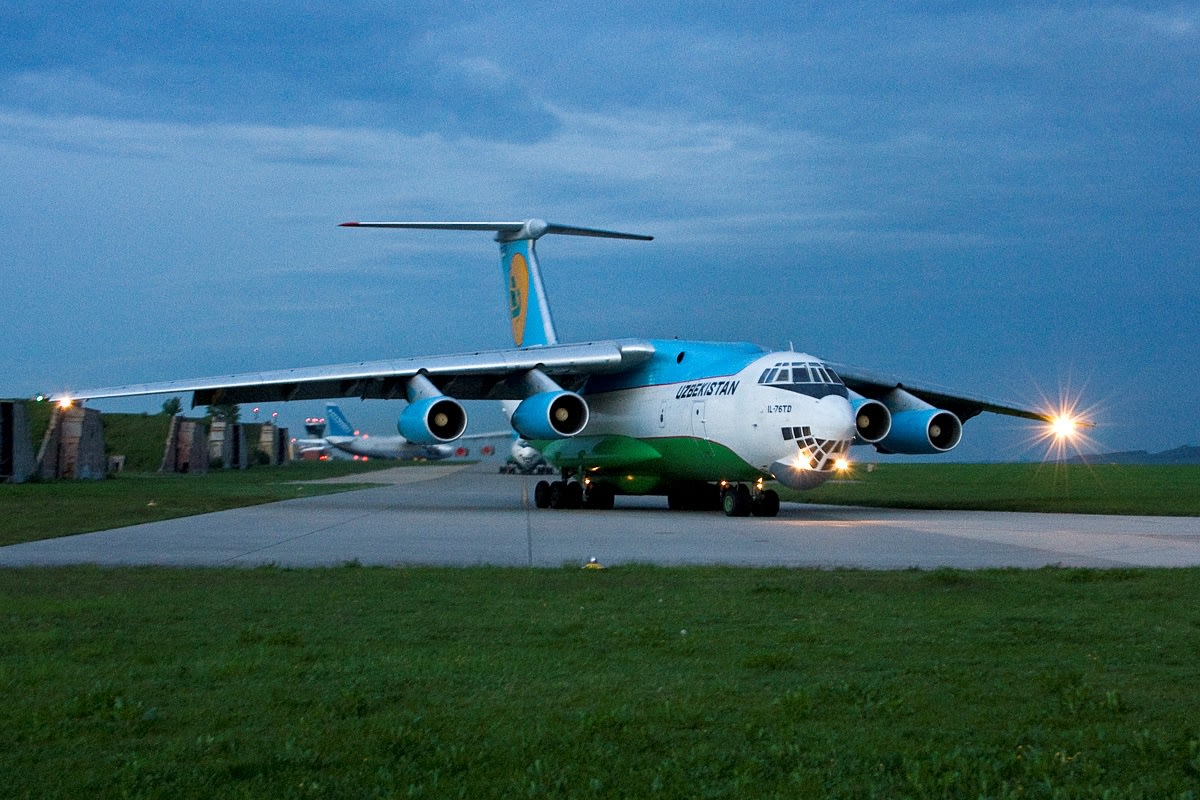
On 6 October 2026, five days after Ethiopia expelled Eritrea’s diplomats, an Ilyushin Il-76 freighter registered XT-ABL took off from Abu Dhabi. Flightradar24, the public flight-tracking service, recorded the departure. It did not record where the plane went. That evening it landed back in Abu Dhabi after a flight of about three and a half hours. For the rest of the week it kept flying out of the Emirates almost every day, from Abu Dhabi and Al Ain.
XT-ABL belongs to Batot Air, an airline registered in Burkina Faso. Its planes do not fly to Burkina Faso. They fly from the United Arab Emirates, and according to an investigation by the French newspaper Le Monde, at least 36 of their trips over four months ended in Ethiopia, with transponders switched off over the Red Sea.
Adulis News followed the paperwork, the airframes and the flight records, and looked at the satellite images ourselves. Here is what the record shows.
A company on paper
Batot Air was registered in Ouagadougou in August 2024 through Burkina Faso’s fast-track company system. According to Le Monde, which examined the country’s commercial registry, it declared share capital of 15,000 euros. Its listed owner is Mohamed Omer Suleiman Idriss, a Sudanese businessman active in aviation. Le Monde found his political ties “remain unclear”.
The airline began flying in November 2025. Le Monde reported that none of its aircraft spent any time in Burkina Faso. Its website offers “cargo charter flights across Africa, Asia, Middle East, Eastern Europe, China, and CIS countries”. It did not answer questions from Le Monde, or from the aviation trade publication ch-aviation.
Fifteen thousand euros does not buy one Il-76. Batot Air has three.
Three freighters out of storage
Each aircraft has a public identity: a registration, a serial number and a transponder code. We traced all three.
XT-ABL (serial 1013409287) is an Il-76TD built around 1992. It was registered in Uzbekistan as UK-76831. According to ch-aviation, it was owned by Uzbekistan Airways, which “apparently never operated it”, and had been stored at Tashkent airport for at least ten years. On 6 November 2025 it was flown from Tashkent to Fujairah in the UAE, under its new Burkina Faso registration and Batot Air’s flight code.
XT-ABN (serial 1003403109) spent most of its life with Uzbekistan Airways as UK-76805. Aircraft registers list it joining Batot Air on 27 January 2026. A spotter logged it at Abu Dhabi airport on 24 April 2026.
XT-ABJ (serial 1013405184) is another Il-76TD, built in 1991, flying under Batot Air’s code.
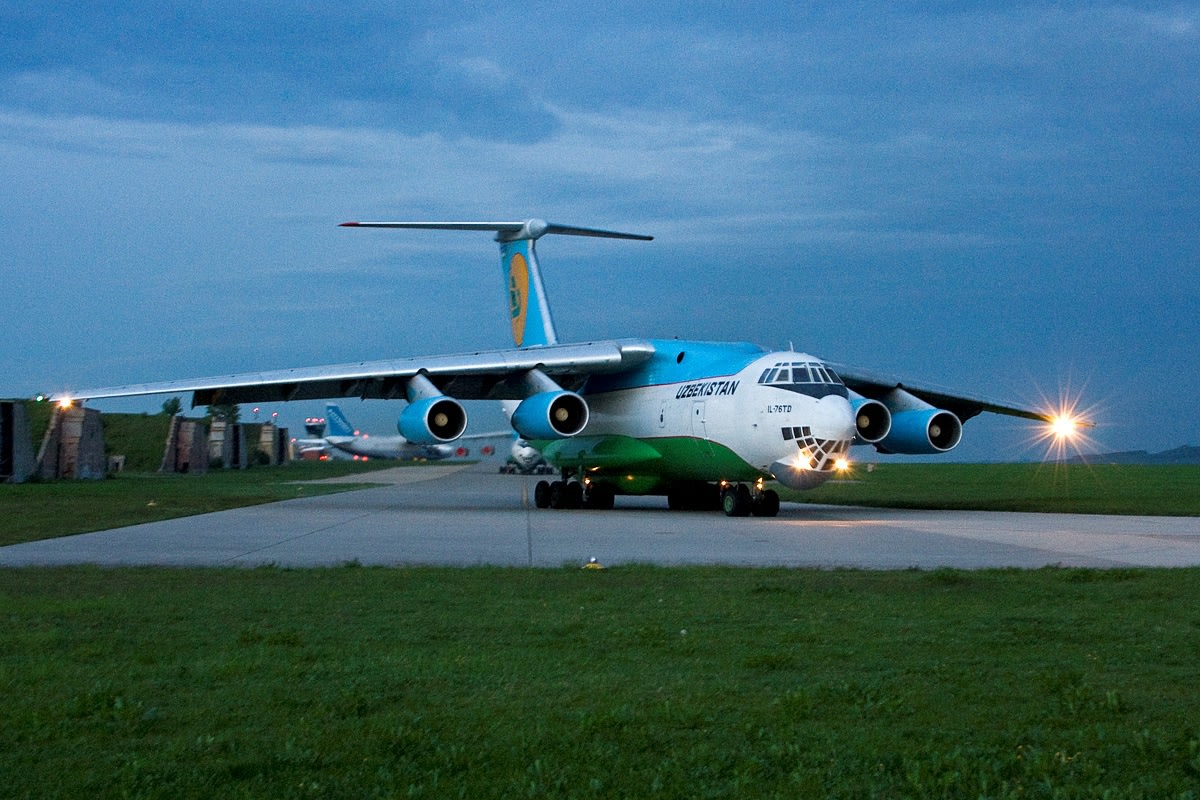 UK-76805 in Uzbek service, at Brno airport. The same airframe now flies for Batot Air as XT-ABN. Photo: MarekV / Wikimedia Commons, CC BY-SA 3.0.
The company also flies two Antonov An-12s, XT-ABA and XT-ABR. Flight trackers report that XT-ABR, formerly registered in Ukraine as UR-CBF, flew from France to Tunis on 25 February 2026 and on to N’Djamena, Chad, two days later.
Old Soviet freighters, bought out of storage, registered in a country they never visit, owned on paper by a company with almost no capital. Le Monde concluded that the source of the money for the planes “remains unclear”.
Where they fly
Le Monde tracked at least 36 trips between the UAE and Ethiopia in Batot Air’s first four months. The planes landed at Addis Ababa’s Bole airport or at the Ethiopian National Defence Force’s air base at Bishoftu. Pilots typically switched off their transponders over the Red Sea. Security sources told the paper the airline also carried Mohamed Hamdan Dagalo, known as Hemedti, the leader of Sudan’s Rapid Support Forces (RSF), and his brother Abdelrahim.
We checked the public record ourselves. Flightradar24’s free history shows seven days of flights. For XT-ABL it shows this:
That is a freighter flying out of the UAE almost every day, with every destination missing from the public record, in the week Ethiopia wrote to the UN Security Council accusing Eritrea of invasion. A flight of about three and a half hours is what an Il-76 needs to reach the Horn of Africa from Abu Dhabi. It does not prove where these flights went. It shows that the public is not being allowed to know.
What the satellites show
Batot Air’s flights fit a wider picture inside Ethiopia. In February, Reuters revealed a camp near Menge, in western Ethiopia’s Benishangul-Gumuz region, where an internal Ethiopian memo said about 4,300 fighters for Sudan’s RSF were in training. Eight sources told Reuters the UAE paid for it. The nearest airport is Asosa.
Adulis News examined every clear image of Asosa airport taken by the European Union’s Sentinel-2 satellites since November 2024. The images are free and open, at 10-metre resolution.
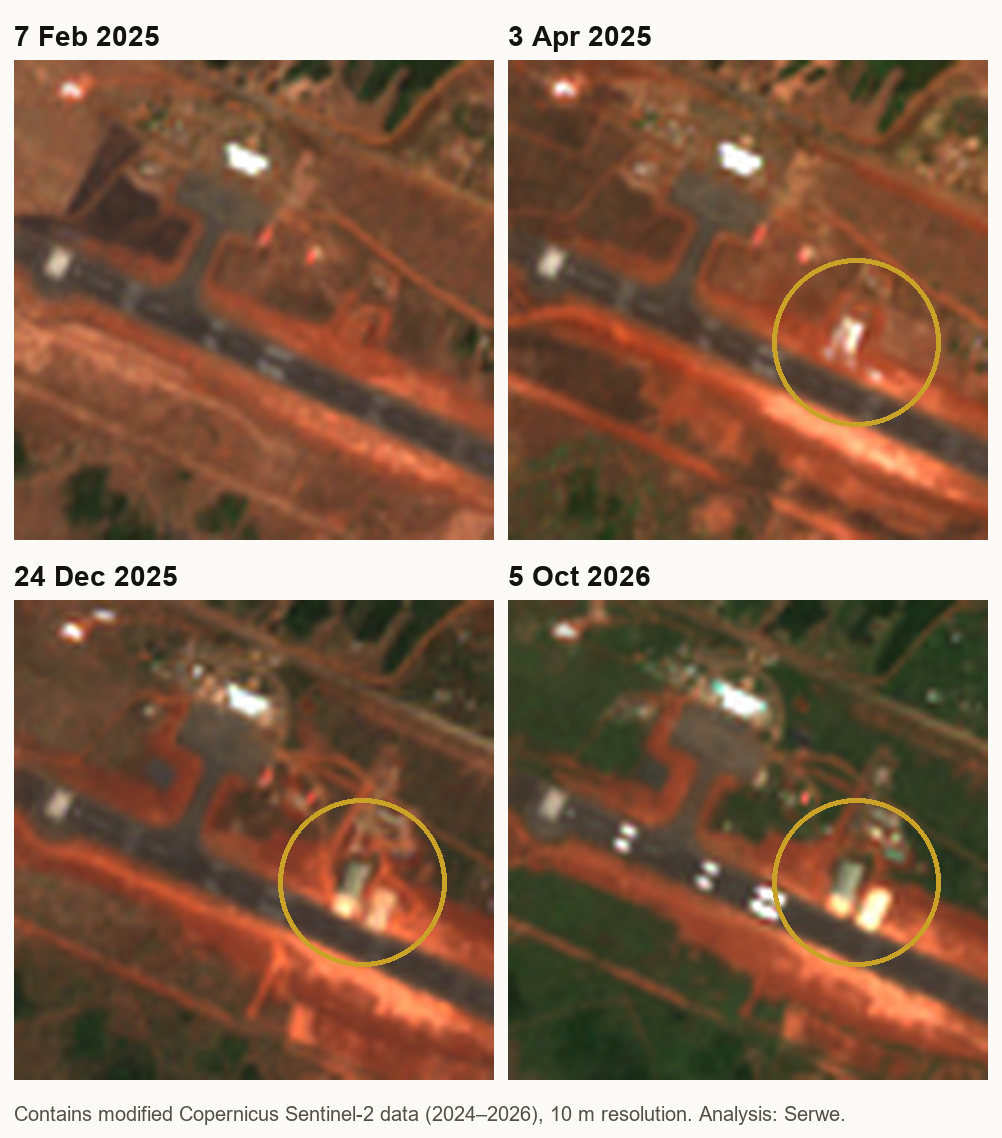 Asosa airport, Ethiopia. In February 2025 the ground south of the terminal is empty. Construction appears by April 2025. By December 2025 two large structures stand beside the runway, with new earthworks along it. Contains modified Copernicus Sentinel-2 data; analysis by Adulis News.
Three changes stand out:
- New structures. Two large buildings beside the runway, south of the terminal, were absent in November 2024 and February 2025. Work is visible by April 2025, and both stand by 24 December 2025.
- Earthworks. Fresh cuts of red soil run along both sides of the runway from December 2025.
- A refreshed runway. Between 27 July and 5 September 2026 the runway gained new white markings at both ends, the pattern of a resurfaced or re-marked runway.
These findings match what Yale University’s Humanitarian Research Lab reported from sharper commercial imagery: a new hangar and concrete pad at Asosa since August 2025, and in late August 2026 about 100 new “technical” vehicles in the Asosa area, pick-up trucks of the kind used as gun platforms, at least five with probable mounted weapons. Sudan’s army says drones that struck it in 2026 were launched from Ethiopian airports. Ethiopia denies it.
Not the first air bridge
Batot Air is new. The pattern is not.
In November 2021, as Tigrayan forces advanced on Addis Ababa, Al Jazeera tracked more than 90 flights between the UAE and Ethiopia in three months, many of them by Il-76s on routes that hid their origin or destination. Satellite images showed a Chinese-made combat drone at Harar Meda, the air base at Bishoftu.
In January 2024, United Nations experts reported Il-76 flights from the UAE, with stops including Ethiopia, to airstrips in Chad. They cited credible information that weapons were unloaded there for the RSF. Reuters later counted at least 86 UAE flights to one of those airstrips, Amdjarass.
Each time, the carriers changed. The aircraft were old, the registrations came from far away, and the companies were small, new and silent. Batot Air fits the pattern.
Why this matters to Eritrea
Ethiopia’s government accuses Eritrea of backing armed groups and of invading Tigray. Eritrea denies both. Addis Ababa presents itself as the threatened party.
The record in this report points the other way. Ethiopian airfields receive a steady flow of unexplained cargo flights from a foreign power. An airport near the Sudanese border has been rebuilt while a camp for a foreign militia grew next to it. And it happens under a government whose leader calls Eritrea’s coast a “mistake” to be corrected. A state that hosts this kind of pipeline is in no position to accuse its neighbours of interference.
What the record does not show
- The cargo. No public document shows what Batot Air carries. Le Monde’s sources describe military supplies; the airline has not said.
- October’s destinations. Flightradar24 did not record where XT-ABL flew on 6 to 10 October. The flight times are consistent with the Horn of Africa, but that is not proof.
- The owner’s role. Le Monde found Mohamed Omer Suleiman Idriss’s links to the RSF unclear. We found nothing to settle that.
- Who paid. Nothing public shows who financed the aircraft.
- Conflicting records. Two aircraft databases list earlier owners for XT-ABJ and XT-ABN that conflict with other sources, including one entry for the Royal Jordanian Air Force. We could not resolve this and make no claim about it.
- The satellite images. At 10 metres, Sentinel-2 shows buildings and earthworks, not their purpose. The new runway markings are paint, not aircraft.
- The denials. The UAE denies arming the RSF and says it is not a party to Sudan’s war. Ethiopia denies supporting the RSF. Batot Air did not respond to Le Monde or ch-aviation.
Questions that need answers
Burkina Faso’s civil aviation authority should say how it oversees an airline whose planes never visit the country. The UAE should say what is loaded onto these aircraft at Abu Dhabi and Al Ain. Ethiopia should say what lands at its military air bases, and why its own airspace swallows the destinations.
Until they do, the record speaks for itself. A company worth 15,000 euros on paper flies three Soviet freighters out of the Emirates, almost daily, to destinations the public is not allowed to see. And the world is told that the threat comes from Asmara.
Sources: Flightradar24 aircraft histories for XT-ABL, XT-ABJ, XT-ABN, XT-ABA and XT-ABR, viewed 12 October 2026; ch-aviation, “Burkina Faso’s Batot Air adds first Il-76TD”, 12 November 2025; Le Monde investigation into Batot Air (February 2026), as reported by Africa Defense Forum (24 March 2026) and summarised in African Narratives, “Rear Base” (3 September 2026); PlaneLogger airframe records; Reuters investigation (February 2026), via Al Jazeera, 9 October 2026; Yale Humanitarian Research Lab reports on Asosa (2026), via African Narratives; Al Jazeera, 6 May 2026 and 25 November 2021; UN Panel of Experts on Sudan (January 2024), via Middle East Eye; Copernicus Sentinel-2 imagery, November 2024 to October 2026, analysed by Adulis News.
Images: UK-76805 by MarekV, Wikimedia Commons, CC BY-SA 3.0. Satellite images: contains modified Copernicus Sentinel-2 data (2024–2026).